
Anode-free cells reach production, and the interface on the current collector
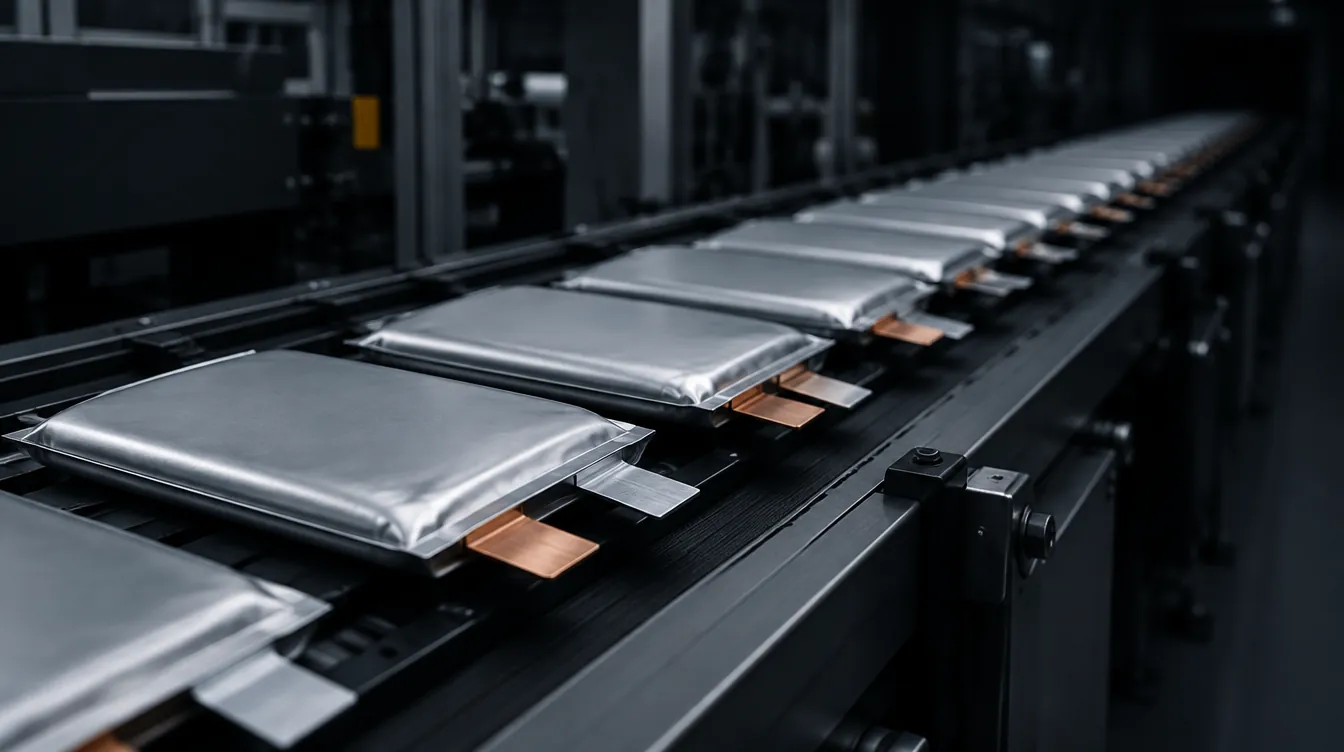
This month solid-state and anode-free cells moved further into production, and demand is spreading beyond EVs to drones and AI data centres.
Industry
| Company | What was announced |
|---|---|
| QuantumScape | Plans for a 100 MWh solid-state line, targeting mass production in 2028 |
| QuantumScape | QS PowerBlock, an in-rack energy storage product for AI data centres |
| SES AI | Chungju (Korea) drone-cell plant ramped to 1 million cells a year, with 3 million a year planned by Q2 2027 |
Announced production timelines
October 2026Announced target
QuantumScape
Oct 2026 100 MWh line announced → 2028 mass production target
SES AI
Oct 2026 1 million cells a year in Chungju → Q2 2027 3 million a year
Both are scaling up, but the figures are self-reported. For anode-free cells in particular, cycle life and production yield have not been disclosed. Independent validation is what will show where these cells really stand.
Research: current-collector interfaces and dendrite detection
KAIST: nanotube copper with an MXene coating. Published in Advanced Functional Materials by a KAIST team with Kyungpook National University and the National NanoFab Center. Secondary sputtering lithography forms tubes about 300 nm across and 150 nm tall on a copper current collector, giving roughly four times the lithium contact area of flat copper. A coating of MXene about 10 nm thick then helps form a LiF-rich protective layer.
Chinese Academy of Sciences: a dendrite-sensing solid electrolyte. Published in Nature Sensors. A composite solid electrolyte turns dendrite penetration into an electrical signal before an internal short occurs. It does not stop dendrites; it warns of them.
Both are lab-scale results; validation under commercial cell conditions is still to come.
Anode-free cells: how to read current collectors and interface layers
In an anode-free cell, the surface of the current collector is where lithium grows, so the collector and the thin functional layer on it decide much of the performance.
- Copper is not the only option. Stainless steel, nickel and titanium can work if they meet conductivity, electrochemical stability and cost requirements.
- Functional layers fall into three roles.
| Role | Example materials | Expected function | Open questions |
|---|---|---|---|
| Lithiophilic nucleation layer | Ag, Au | Even nucleation and plating of lithium from the start | Alloying, oxidation and adhesion depending on thickness, layer order and electrolyte |
| Alloying layer | Mg, Zn, Sn | Alloys with lithium to suppress local dendrite growth | Redistribution and volume change of the metal over repeated cycles |
| Protective layer | LiF | A stable artificial SEI that blocks side reactions with the electrolyte | Interfacial resistance and overpotential from its low conductivity |
The FLUX view
Anode-free and lithium metal cells are entering high-value markets such as drones first. What they need now is a process that makes the functional layer on the current collector uniform at the nanometre scale, over large areas.
Source
- QuantumScape Q3 2026 shareholder letter
- QuantumScape announces QS PowerBlock for AI data centers
- SES AI completes ramp of Korea drone battery plant to one million cells per year
- Herald Corp: KAIST nanotube copper current collector (Korean)
- A dendrite-sensing composite solid electrolyte for smart lithium batteries, Nature Sensors (2026)